

A personality configures the testing agent — Cekura’s simulated caller — not the agent under test. It owns everything about how that caller sounds and behaves for the whole call; the evaluator owns what the caller is trying to get done. Evaluator instructions cannot change anything on this page, so a call-wide trait belongs here. See Personality for the full split.
Accent comes from the voice
A personality’s accent is a property of the voice you select, not a field you fill in — speech is synthesised from the voice ID alone, which is why there is no accent input on the create form. Theaccent shown on a personality is a read-only label derived from that voice, and it is empty for providers that publish none (all Cartesia voices).
To pick a voice by accent, browse GET /test_framework/v1/personalities/elevenlabs_voices/?language=en, which carries an accent label per voice. See Accent Testing for the full workflow.
If no available voice has the accent, language or timbre you need, the catalog is not a hard limit — Cekura can add voices on request. Reach out at support@cekura.ai or via your dedicated Slack support channel.
Getting Started
1. Access the Dashboard
- Log in to your account at dashboard.cekura.ai
- Navigate to the Personalities section from the sidebar menu
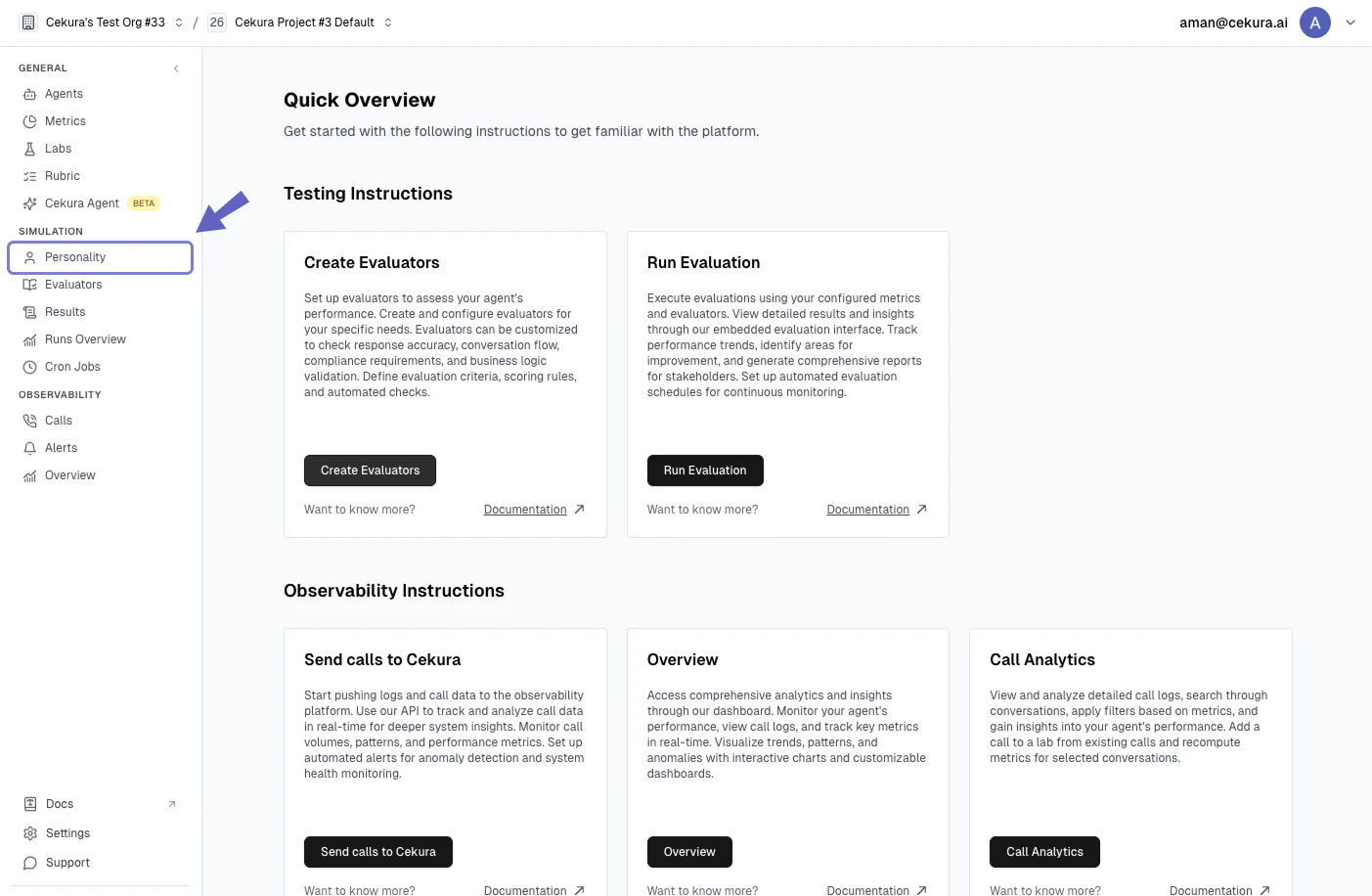
2. Creating a New Personality
You have three options for setting up personalities:- Use Pre-defined Personalities: Choose from Cekura’s curated collection of optimized personalities
- Fork a Pre-defined Personality: Copy one into your project and change only what you need — everything else is inherited
- Create Custom Personality: Design a completely new personality from scratch
Pre-defined personalities are shared across all workspaces, so they cannot be edited directly. Fork one when you want to keep its voice and accent but change its behavior — for example to raise the idle timeout. Forking is also the quickest route to a custom personality, since you don’t have to re-pick the voice settings.
To create a custom personality:
1. Click the “Create Personality” button in the Personalities section
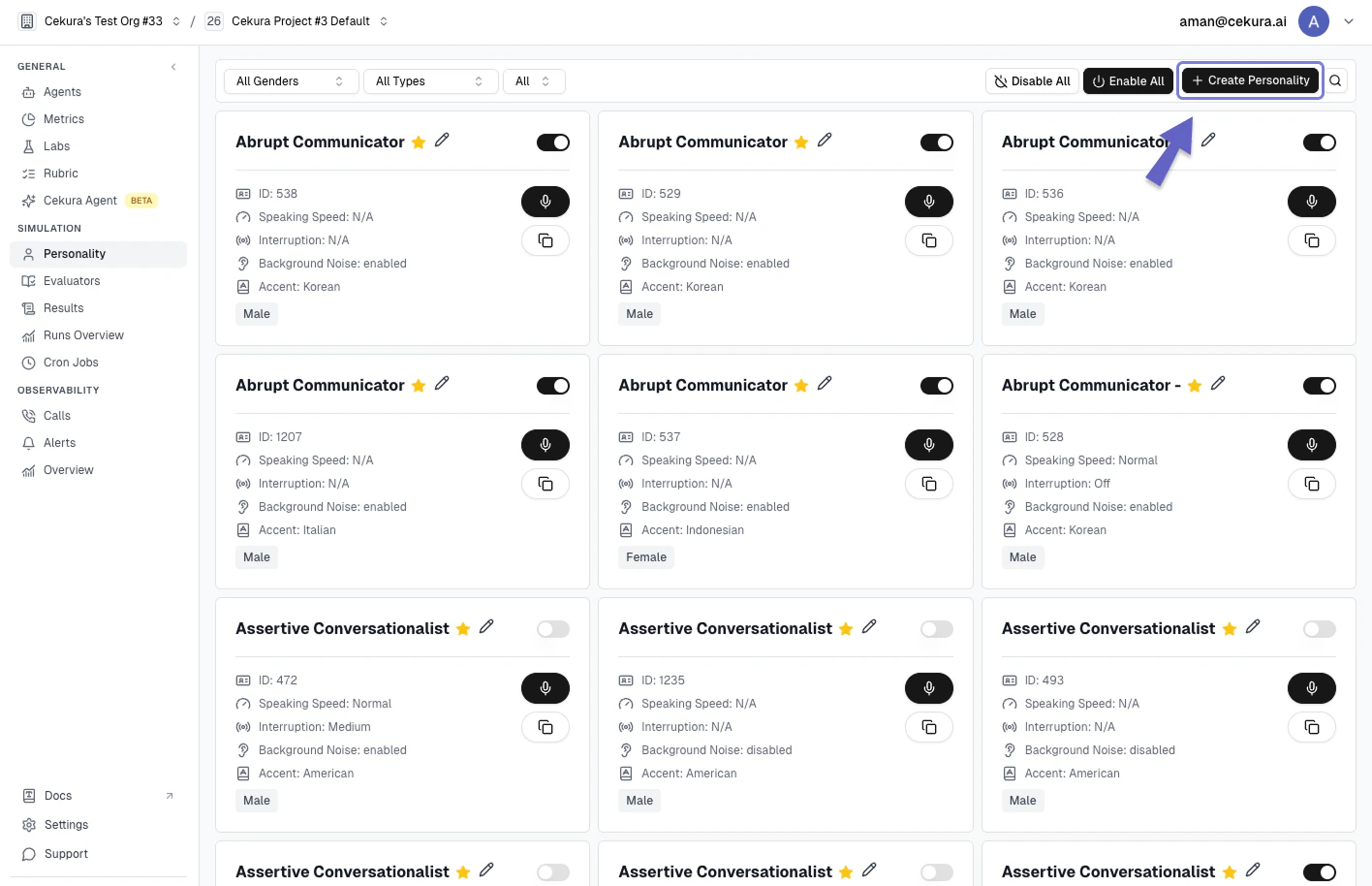
2. Fill in the following required fields:
Basic Information
- Personality Name: Give your personality a unique, descriptive name
- Personality Description: Briefly describe the personality’s purpose and characteristics
Behavior Configuration
- Personality Prompt: Define how the simulated caller behaves and responds throughout the call — its persona, tone and attitude. This shapes word choice, not pronunciation: an accent written here will not change how the voice sounds.
Voice Settings
- Background Noise: Control background noise during conversations. The dropdown offers several options including built-in noise presets and a Custom URL option — select “Custom URL” and enter a direct link to an audio file (e.g.,
https://<your-domain>/background.mp3) to play any sound file as background noise during the simulation. - Voice ID: The voice the caller speaks with. This determines the accent and the perceived gender, both of which are then shown on the personality as read-only labels. Preview voices in the picker before choosing.
- Voice Provider: ElevenLabs or Cartesia. The voice model must belong to the selected provider (
eleven_*models with ElevenLabs,sonic-3.5with Cartesia).
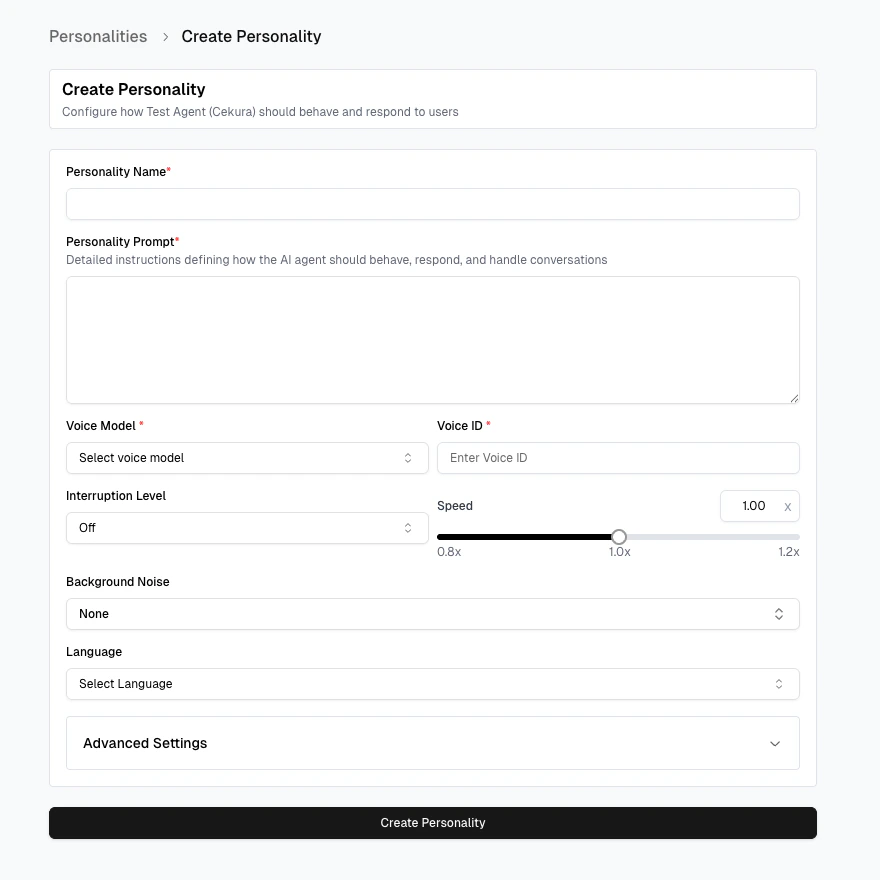
Advanced settings
Open the Advanced Settings section of the personality form for these. They control how the testing agent behaves during a call, and cannot be set from an evaluator — instructions and expected outcomes only control what the testing agent says, so anything in this section has to be configured here.
Both idle fields must be set together, and both must be 1 or greater — the idle prompt can be pushed out but not switched off entirely.
Updating a personality over the API
The same fields are available programmatically:- Fork Personality — copy a personality into one of your projects
- Update Personality — change any setting on a personality your organization owns, including a fork you just made
Update the fork with a longer idle timeout
Next Steps
After creating your personality, you can:- Assign it to specific agents
- Test interactions
- Monitor performance
- Make adjustments as needed